
Not only men should engage in strength training. A growing number of women are using exercises like those performed on parallel and horizontal bars to increase their muscle mass, gain strength, and develop an athletic, toned body. With just a few basic pieces of equipment, you can work out your entire body, focusing on important regions like your back, arms, and core.
Beyond the benefits of traditional weightlifting, functional strength can be developed through bar training. It increases general coordination, makes use of your body weight, and activates stabilizing muscles. This is a very effective and demanding workout for anyone looking to gain muscle and improve endurance.
This program is made to lead you through exercises that get harder and harder over time, assisting you in reaching your fitness objectives. This routine contains elements that can push your limits and make you stronger, regardless of your level of experience.
- Rules and recommendations for training on horizontal bars and parallel bars
- Is it possible to pump up on a horizontal bar and bars?
- Advantages and disadvantages of exercises on the horizontal bar and parallel bars
- Types of grips
- Regime and frequency of classes
- Frequent errors
- Women"s complex of exercises on the horizontal bar and bars
- Warm -up
- Exercises for the chest
- Abdominal exercises
- Stretching
- Training plan
- The best exercises on the horizontal bar for girls
- Hanging
- Pulling the knees to the chest
- Hanging leg raises
- Hanging crunches
- Corner
- Australian pull-ups
- Horizontal bar and parallel bars training program for beginners
- A program of training on the horizontal bar and parallel bars for mass
- Training program on the horizontal bar and bars on the relief
- Training program on the horizontal bar and bars on force
- Contraindications to exercise
- Video on the topic
- Super training program for sports grounds. 10 minutes a day. 3 times a week. Do it and everything will be!
- Effective training program on horizontal bar and bars per mass!
- The best split for training. Which program is better for recruiting muscle mass
- How to gain muscle mass on horizons. Workout in the United States with pitching on the streets of New York
- Workshop training program for mass gain!
- I pumped up on the horizontal bars, and here"s how 😈🦾 #Training is a #hovylice #Brusya #how to get
Rules and recommendations for training on horizontal bars and parallel bars
The horizontal bar and parallel bars offer a great way to tone your entire body, burn extra fat, and build your arms, chest, and back muscles. Training under a trainer’s supervision is not required. You have the option to select the program.
To optimize productivity, you ought to follow these few easy guidelines:

- training should be regular – only then will they give results;
- you should not overload your body – it is much more useful to perform a constant load every workout;
- optimal load is determined by trial and error. The field of exercise should remain a feeling of fatigue, but not so strong as to interfere with classes next time;
- The norm of exercises should be individual, even if classes take place in the group;
- Group classes are useful to have additional motivation, but it is important to choose a group suitable in terms of preparation;
- The main criterion for choosing a set of exercises is the level of preparation, for most girls it is low;
- The second criterion is the correspondence of the chosen goal (growth of muscle mass, the fight against excess weight, maintaining a common tone, etc.D.)
For girls, training on parallel and horizontal bars can be a simple and efficient method of increasing muscle mass, strength, and muscle definition. The arms, shoulders, core, and back are among the major muscle groups that this program helps target by emphasizing bodyweight exercises like pull-ups, dips, and leg raises. Without the need for bulky gym equipment, girls can improve their overall fitness and physique while gaining functional strength at their own pace with consistency and proper technique.
Is it possible to pump up on a horizontal bar and bars?
It works incredibly well and is feasible. Mice must lift their own body weight while working, which is a significant load. If the exercises are getting too easy, you can try adding more approaches, adjusting the height of the bars, or using specialty weights, which are placed on the legs to increase body weight.
Almost anyone can perform exercises on the horizontal and parallel bars.
The outcomes will differ based on factors such as training frequency, regime details, and natural data, but they will undoubtedly differ. Consequently, if pumping up is the aim, it will be accomplished carefully.
Regular exercises on the horizontal bar will aid in the harmonious development of the body because, in addition to improving the tone of the upper body muscles, they also strengthen the back, press, and partially the legs (for the latter, we will discuss additional exercises).
Advantages and disadvantages of exercises on the horizontal bar and parallel bars
The horizontal bar is still very well-liked by those who lead active lifestyles. More recently, a different approach has surfaced for tricks on the parallel and horizontal bars. This is because they are readily available; you can find a horizontal bar in any yard, and if you would rather stay inside, you can install one in your doorway at home.
Although they are a little more difficult to find, parallel bars are also present in parks and outdoor sports fields. There are essentially no financial costs associated with training on parallel and horizontal bars because you don’t need to purchase any additional equipment. The second benefit is the variety and ease of use of the exercises available on the horizontal bar.
Without seeking advice from a trainer, you are able to select a program that will develop all of your body’s muscles in harmony. Parallel bar exercises are safe and can be suggested to beginners because it’s more likely that they won’t be able to perform the exercise correctly and get hurt than that they won’t be able to perform it at all.
However, in addition to the benefits, there are drawbacks that are intimately connected to the benefits. Only in nice weather can you work out in the yard; in the winter and when it’s raining, you’ll either have to pay for a gym membership or give up on exercising.
For novices, the exercises are fairly challenging.
When it comes to girls, a significant number of them struggle to complete the exercises on their first try, which deters them from participating in such activities and saps their motivation. People with inadequate training end up "at the tail," finding it most difficult to exercise, and eventually leaving the group if the classes are held in a group setting. However, this drawback exists in all group classes.
Types of grips
There are frequently disagreements among athletes regarding the proper way to grip the horizontal bar. Actually, there is no right or wrong grip; instead, the load is distributed differently across all necessary and practical options.
Different kinds of horizontal bar grips:
- Straight – both hands are turned with fingers away from the athlete"s face. Reduced load on the forearm muscles.
- Reverse – hands are turned with fingers towards the athlete"s face. Increases the load on the forearm muscles.
- Heteronymous – one hand is held with a straight grip, the other with a reverse grip. Result – uneven load on the forearms. It is necessary to change hands.
- Narrow – the distance between the hands is less than the width of the shoulders. Can be straight, reverse or heteronymous. Increases the load on the shoulder muscles.
- Parallel – arms shoulder-width apart. The load falls on the arms, shoulder girdle, back and chest.
- Wide – arms wider than shoulder-width apart. The main load falls on the back, chest and shoulder girdle.
- Lock – hands clasped in a lock around the bar.
It is only possible to perform exercises on the bars with a straight grip; no other configuration is possible. The exercises’ difficulty can be altered by varying the space between the bars.
Regime and frequency of classes
The effectiveness of the horizontal bar and parallel bar training program depends on students adhering to the classroom rules.
The classes are organized as follows:

- warm-up with an emphasis on the shoulder girdle and arm joints;
- exercise in several approaches;
- between approaches – exercises for other muscle groups;
- after completing the complex – exercises to restore breathing.
Stretching exercises can be included in the complex. Novices can stick to a single strategy and incorporate the others as they can. The desired outcome determines how frequently a person trains.
You should follow the 1+1 strategy, which calls for one day of active loads and one day of rest, to gain maximum muscle mass.
Muscle tissue is actively growing while you sleep. The plan can then be made more complex by scheduling multiple training days consecutively. Daily light-intensity training is crucial for maintaining tone. They will help you stay in shape but won’t increase your muscle mass.
Frequent errors
There are challenges with the horizontal bar exercises that should be considered in class.
The following table lists typical errors and guidelines to help you avoid them:
| Correct execution | Mistakes | |
| Breath | Inhale in the starting position, exhale – at the time of the largest load | Arbitrary breathing. The athlete gets tired faster, performs less approaches |
| Hand movements | Smooth, elbows do not extend completely | Sharp movements and full extension elbows increase the risk of injury |
| Muscles not involved in the exercise | The neck is completely relaxed, the legs and the press are tensed only when the technique of exercise requires this | The tension of the "extra" muscles reduces the effectiveness of the main load |
| The use of weighting agents | Only experienced athletes use weighting agents | Too early the transition to classes with weighting agents increases the risk of injury, accelerates fatigue |
Women"s complex of exercises on the horizontal bar and bars
There are no significant differences between the male and female training programs for the horizontal bar and bars. The primary distinction is that girls are typically less trained than boys, so they must begin classes with lighter weights and less strenuous exercises. However, over time, girls’ performance is on par with that of young men.
Warm -up
Warming up before training is essential because it helps you get your muscles, respiratory system, and circulatory system ready for vigorous activity and lowers your risk of injury. The warm-up takes five to ten minutes. Exercises for the hands, lower back, neck, shoulder girdle, and legs are included.
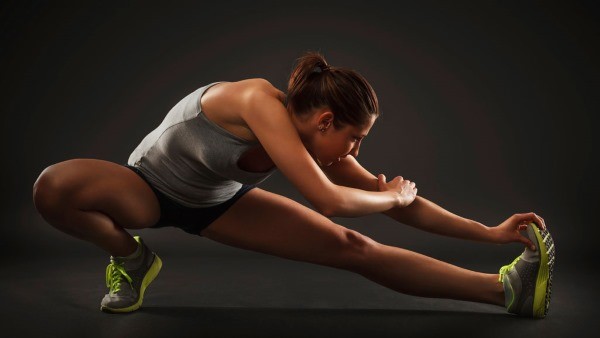
Special focus should be placed on the arms and shoulder girdle. Rotations in the shoulder warm-up should include warming up the elbows and wrist joints in opposite directions.
Exercises for the chest
Arm strengthening and muscle relaxation are achieved through exercises targeting the chest and back muscles. Contrary to popular belief, the chest will not appear more attractive and well-groomed with toned shoulder girdle muscles because the mammary gland does not have muscles of its own. Instead, the chest will appear the same as it did prior to training. If your breasts are small (size 1-2), the appearance can only be greatly enhanced.
Pull-ups are done with a wide, reverse grip to build the chest muscles on the horizontal bar; the number of approaches varies depending on training level. For the same reason, different kinds of push-ups are performed on the bars, including diagonal, thoracic, and corner push-ups.
Abdominal exercises
The rigorous training regimen on the parallel and horizontal bars includes exercises designed to develop the body’s harmony throughout.
Abdominal exercises performed on this type of equipment require more effort from the abdominal muscles because they are harder to perform than standard floor exercises involving bending and unbending the torso; additionally, the press works harder and the results are more pronounced.
On the horizontal and parallel bars, similar abdominal exercises are done by raising the knees, followed by straight legs, twisting, and raising the toes to the shoulders. Dosing the loads will be made easier with an accurate assessment of your level of fitness and body awareness.
Stretching
After working out, muscles need to be stretched to release tension. It can be done at a leisurely pace to facilitate breathing recovery from exercise. Girls are also certain that stretching will prevent their muscles from growing too quickly, form relief without becoming overly voluminous, and maintain their feminine appearance.

Pulling a straight arm to the opposite shoulder and bending an elbow behind the head are two basic arm-stretching exercises. In the first scenario, you must draw your arm down; in the second, you must draw it towards the body with your free hand. Stretching exercises must be done very carefully to avoid damaging the joints and ligaments.
Training plan
For each person, a customized training program in parallel and horizontal bars is created. The best course of action for a beginner is to train every evening to keep in shape or to build muscle mass using the 1 + 1 scheme. Every session should commence with a warm-up, followed by three exercises performed on either parallel or horizontal bars, followed by stretching and breathing recovery.
Prior to creating a training schedule, you must select exercises that will help you reach your goal. It is preferable to perform the same complex of three exercises per day, targeting different muscle groups (chest, arms, and abs), in order to maintain athletic shape.
You should choose three exercises for each muscle group and alternate them (arm day, chest day, abs day) if your objective is to gain muscle mass. Separating the exercises on the parallel and horizontal bars into separate days is convenient. Even for those who do not excel in physical fitness, results can be seen within a month if the training plan is properly designed.
The consistency of training and the proper performance of exercises are crucial. Should the outcome not meet expectations, the training regimen can and ought to be modified to accommodate unique attributes. For instance, you can find pre-made training plans online, but you should be ready for the possibility that they might work for someone and that someone else will need to tweak them.
The best exercises on the horizontal bar for girls
It is advisable for girls to begin training with relatively easy exercises as this will help them become more acclimated to physical activity and enhance their body’s overall tone. Exercises on the horizontal bar will help a girl lose extra weight, tone her figure, and improve her physical fitness even if she is unable or unwilling to pump up her relief.
Hanging
The easiest exercise you can perform on a horizontal bar is hanging. It’s not done with parallel bars.
The following is how to hang from a horizontal bar:
- The horizontal bar should be slightly higher than the athlete"s height with raised arms (so that when hanging, it does not reach the floor);
- The correct grip is parallel or slightly wider than parallel;
- The legs can be straightened or bent at the knees, the elbows should be straight (the only exercise on the horizontal bar with straight elbows), the head is tilted forward;
- The body relaxes and remains in this position for 3-4 minutes.
Hanging is an excellent way to begin exercising. The primary objective of hanging is to straighten the spine and relax the arms, neck, and back muscles. This aids in overcoming the negative effects of an overly strenuous lifestyle as well as excessive strength loads.
Pulling the knees to the chest
This press exercise is excellent for newcomers. It is executed on parallel and horizontal bars.
Method for acting on a horizontal bar:
- starting position – hanging with slightly bent elbows;
- legs bent at the knees, brought together, in this position raised to chest level;
- return to starting position.
Every move is executed with grace, even the one where you go back to the hang. It will be challenging to raise your legs to the appropriate height during the early phases of training, but you must make an effort to raise your knees as near to the proper position as you can. You will eventually be able to complete the exercise correctly. The most frequent error is attempting to abruptly raise your legs.
This puts your elbows at risk for injury and is less efficient than smooth lifts. The initial posture on the bars is as follows: the elbows are slightly bent, and the arms support the body above the apparatus. While ab exercises on the bars are comparatively simpler, the strain on the arms is greater.
Hanging leg raises
Beginning position: just like in the last exercise, hang on the bar. The lift must be done in phases, especially for inexperienced users.
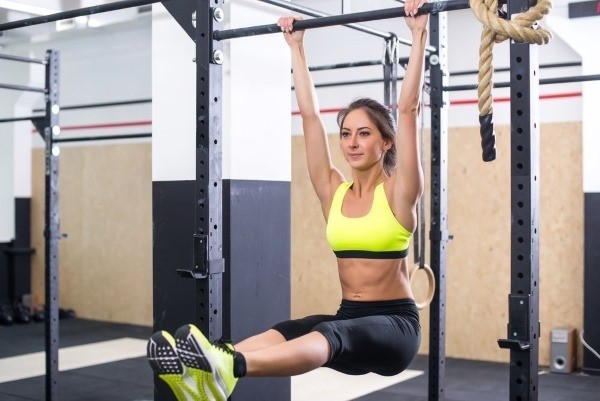
Order of action:
- hanging (starting position);
- raising knees to chest;
- straightening legs so that feet are above the bar (be sure to raise the pelvis);
- return to the starting position (possibly through knees bent at the chest).
The exercise tones the back, buttocks, and thigh muscles as well as the abs. executed by seasoned athletes on the bars.
Don’t miss the section’s most popular article, Morning Exercises for Over 40 and Over 50. Weight loss gymnastics exercises and video lessons.
Hanging crunches
You execute crunches upside-down. You must bend and unbend your torso while holding onto the bar with your knees in order to accomplish this. Once you have mastered hanging leg raises (also known as reverse crunches), you can perform this exercise.
Corner
Another abdominal exercise. executed while suspended from the bar. The exercise gets its name because you have to raise your straight legs to a horizontal position from this position so that they make a right angle with your body. If you’re training endurance, you should hold this position for at least ten to fifteen seconds. executed on parallel and horizontal bars.
Australian pull-ups
This is a less complex pull-up exercise performed on a horizontal bar. The bar is positioned lower than usual, and when the body is in the starting position, it is either horizontal or angled, with the heels touching the ground. Your face should be above the bar as you pull your shoulders to the bar during a pull-up.

In this instance, only a portion of the body weight is raised by the arms. You must gradually raise the bar and transition from Australian pull-ups to classic pull-ups over time.
Horizontal bar and parallel bars training program for beginners
Beginner training programs for parallel and horizontal bars include streamlined workouts. You should begin slowly, by hanging for just a short while each day, until you have at least thirty minutes each week spent in this posture. This will ease the strain on the back muscles and vertebrae, lowering the possibility of further injury.
After that, you can progress to pull-ups. You can start with the Australian version or ask someone else to insure if the person is unable to do it on their own. The following is the order in which ab exercises are done: crunches, leg lifts, and knee pull-ups. It is best to have someone insure the person performing them initially.
Beginners can incorporate knee lifts, pull-ups, and hanging into their daily routine.
Even half-completed exercises help to build muscle and get us closer to the day when they will be performed correctly and moving on to more difficult ones will become popular.
A program of training on the horizontal bar and parallel bars for mass
You need heavy loads if you want to gain muscle mass. When deciding whether to classify the training as medium or high, this is something to consider. For every part that needs to be pumped up, a set of exercises is designed.

Exercises consisting of one or two segments and pressing are done for training. The more approaches, the better; however, each approach should only be used up to eight times in total. Training schedule: 1+1, 2+1, and so forth. Working with the torso and weights is acceptable.
Training program on the horizontal bar and bars on the relief
A good exercise for people who have reached their ideal muscle mass is working out for relief from muscle tension. It necessitates not only carefully chosen loads but also adherence to a drying diet. The exercises chosen are meant to build the desired muscle groups.
Training program on the horizontal bar and bars on force
When you pull up for force, you have the chance to practice both relief and volume simultaneously. Intense loads must be combined with insulating exercises (on relief) to accomplish this. The workouts are tailored to specific body parts and include strength, isolation, and ab exercises. The program is structured similarly to mass classes.
Contraindications to exercise
A major reason not to work out on the parallel and horizontal bars is if you have any injuries to your arms or shoulder girdle (joints, bones, ligaments, muscles). The exercises are impossible to do correctly, and it is very easy to aggravate an injured area further. When it comes to spine disorders, you ought to see a physician.
Overall suggestions in this instance:
- scoliosis – exercises are allowed and useful;
- kyphosis – only a straight grip, preferably weights;
- lordosis – back bends are contraindicated;
- osteochondrosis – feasible training, only a smooth descent from the horizontal bar;
- intervertebral hernia – an absolute contraindication;
- consequences of a spinal fracture – usually a contraindication.
Diseases affecting the blood vessels in the brain, the bones, and intercostal neuralgia should all be treated cautiously. For any level of fitness, a training program on parallel or horizontal bars can be chosen. Novices can begin with a simple hang, while seasoned athletes can select a challenging series of exercises targeting specific muscle groups.
Anna Vinnitsa designed the article.
| Exercise | Description |
| Pull-ups | Use an overhand grip to strengthen your back and arms. Start with assisted pull-ups if needed. |
| Push-ups on parallel bars | Target your chest and triceps by lowering your body between the bars and pushing back up. |
| Leg raises | Hang from the bar and lift your legs to engage your abs and core muscles. |
| Dips | Work on your triceps and chest by lowering and raising your body on the bars. |
| Inverted rows | Lie under the bar, grab it with both hands, and pull your chest toward the bar to build back strength. |
For girls, training on the parallel and horizontal bars is an excellent method of increasing muscle mass, strength, and definition. These exercises are very practical and effective at building a toned, balanced body because they use only your own body weight.
You can progressively see improvements in your power, endurance, and overall body composition by adhering to a regular program. It’s crucial to concentrate on good form and progressively up the ante as your strength increases. Consistency and patience are essential.
Training on the horizontal and parallel bars can be an empowering addition to your fitness routine, regardless of your goals—muscle toning, mass gain, or just feeling stronger. Your confidence will soar along with your physical transformation as a result of your progress.


