
When walking through the center of Moscow, the name “Kitay-gorod” can be misleading. This place has nothing to do with China. It is one of the oldest districts of the capital, adjacent to the Kremlin walls. Its history is the history of trade, power, and the very soul of Moscow.
The heart of Kitay-Gorod is its famous streets: Varvarka, Ilyinka, and Nikolskaya. Each of them has maintained its specialization for centuries. Ilyinka was the financial center, where bankers and merchants conducted their business. Nikolskaya was famous for its bookshops and education, while Varvarka led to a lively pier on the Moskva River.
Today, walking here, you see a unique fusion of eras. Art Nouveau buildings stand next to ancient temples and monasteries, and old chambers neighbor modern cafes. This is a place where you can feel the authentic historical fabric of the city, hidden behind the grand facades of the main streets.
Kitay-Gorod is not about China or a tourist attraction, but one of the oldest historical places in the center of Moscow. Located next to Red Square, it is an area rich in architecture, business life, and a palpable atmosphere of the past. Despite its name, it has no connection to China — it was named so because of its resemblance to a walled fortress. Today, it is a mix of old mansions, modern offices, and bustling streets, and Kitay-gorod remains an important part of Moscow's image — not just an architectural monument, but a living space where life is in full swing every day.
Polytechnic Museum and Amphitheater

Closed for restoration until November 2020.
Polytech is a kind of Frankenstein's monster: it was built by several architects over almost 30 years. And in 1907, when the museum finally opened, this pseudo-Russian style was already so last season, the fashion for it had faded away. First, the central part was built, then the south wing with commercial premises, and ten years later, the north wing. In short, it was complicated and heterogeneous, which is why the building looks different from all sides. People who work at the Polytechnic say that because of this, there are inconsistencies in the layout—the ceiling may be at different levels in two adjacent rooms.

From left to right:
Alina Kvirkvelia, Georgy Aigunyan, Svetlana Vasilyeva, Olga Polishchuk
Polytech was originally an independent museum and was built on the initiative of the Society of Lovers of Natural Science, Anthropology, and Ethnography. The first floor had huge floor-to-ceiling windows and housed shops so that the museum could support itself. Smart, retail on the first floors at the beginning of the century. After the current restoration, they will be preserved, and anyone will be able to enter here from the street. The first technical floor of Polytech will now be open, free exhibitions will be held here, and in fact, it is a heated public space in the center of Moscow. The amphitheater at the Polytechnic — it is also a metro exit and an observation deck overlooking the building.
After restoration, Polytech will surely become a new place of power and connect several districts.


Monument to the Heroes of Plevna and Ilyinsky Square
We are in an interesting “viewpoint” location — from here you can see the Kremlin and its walls. The Polytechnic is behind us, and Maroseika and Pokrovka begin at the monument — a kind of 17th-century Rublevka. There are many churches and merchant mansions on these streets. How to establish contact with the tsar? That's right, build a house on his way to his dacha. Pokrovka was a real thoroughfare, and later became lined with shops. And by the way, the money for the improvement of the pavements was collected from the courtyards and shops located on the street.
Monument to Russian grenadiers who fell in battle near Plevna during the Russo-Turkish War of 1877–1878
The dome of the synagogue is clearly visible from the square; incidentally, it was only restored in 2001 under Luzhkov. According to a legend that local tour guides are very fond of, in the 19th century, Grand Duke Sergei Alexandrovich was passing by the construction site of the synagogue and crossed himself, thinking it was an Orthodox church. He realized his mistake later and ordered the silver dome to be removed and the building to be sealed. Thus, the persecution of Jews began again in Moscow. In fact, the dome was removed under Governor-General Vladimir Dolgorukov. He was loyal to the Jews (and, in fact, helped them build the synagogue), but the dome was removed at the request of the chief prosecutor of the synod, Konstantin Pobedonostsev. Nevertheless, the synagogue was used for its intended purpose.
Today, it is the largest synagogue in Moscow, and persecution now targets teenagers in Gorki Park, who hang out there at all hours of the day and night, drinking heavily.
Initially, Gorki was conceived by local residents who fought for a park instead of a parking lot, but then teenagers started coming here—it was this place that first attracted young people, not Yama. It is a fairly large, rowdy crowd that has been taking over McDonald's on Maroseika, the neighboring square, Yama, Gorki, and the surrounding courtyards for the past year.
In general, thanks to Kitay-Gorod, it became clear how many teenagers there are in Moscow and how little the city has to offer them. That is why they are beginning to occupy neighborhoods—not because they are occupiers, but simply because they also need their own place in the city.

It starts at Solyansky Proezd and ends at Yauzsky Gate Square. One of the oldest streets in Moscow, the beginning of the ancient road to Ryazan

There are many old hangouts around Solyanka — cheburek shops, the Lyudi kak Lyudi café, which hasn't changed in decades, and the most delicious shawarma place in Moscow. Recently, two Italians opened a very tasty pizzeria here, but they weren't very lucky with the location. The corner at the entrance to the restaurant is a favorite spot for local hooligans: there is a store nearby that sells alcohol around the clock. But it is combinations like this that make Kitay-Gorod so interesting.

It is clear that this is the only truly residential area in the city center. This is evident from the buildings — the ground floors have been home to shops and workshops for centuries. Today, little has changed, except that our needs have grown; now we need key repairs, cafes with Wi-Fi, and fresh coffee in the morning. And of course, everyone remembers the Solyanka club (an establishment that combined a restaurant, club, and fashion store, which closed in 2014 — The Blueprint). I know Moscow thanks to this club; it was my home away from home with the best nights. There, I met the coolest people and made friends. Like half the city, for that matter.


The White City (Kulishki tract) was created and donated to the city in 1824 by Major General N. Z. Khitrovo.


During Luzhkov's time, there were plans to build another building here, but local activists fought to preserve the historic square. In the end, this park is a compromise. But the hill was filled in. Now there are many lanterns and benches here, because they are cheaper to build than planting trees, and you can read the history of Khitrovka on special plaques. In general, there used to be a market on the square where women sold food and clothes directly from themselves, and groups of migrant workers came from the train stations, who were taken to work in the mornings by contractors. Gilyarovsky described this place as a flea market. Surrounding it all were night shelters and the notorious taverns “Katorga” and “Siberia,” where escaped convicts would flee. Khitrovka hid many people.
It is said that Gorky based the characters in his play “The Lower Depths” on the patrons of these taverns. As for Gilyarovsky's stories, there is a view that the writer often exaggerated. As a journalist and reporter, he needed to instill fear.
Yaroshenko House is located on Hitrovka Street. It is a unique residential building in Moscow, where a piece of plaster fell on restorer Nikolai Avvakumov, revealing 17th-century masonry. Now, layer by layer, layers of architecture and everyday life are being found in one building. It is a unique object. This house is literally a layered cake of Moscow's architectural styles and an open-air museum of everyday life. It is being restored with money from the Hitrovka charitable foundation and donations. It is a unique piece of Moscow, and every detail may be the last remaining one.

Kholovka and the Blanc restaurant
The neighborhood between Zabelina Street, Solyanka, and Morozovsky Garden


Kokorev's House is a unique place. Originally a 17th-century mansion, it later housed the archives of the Foreign Affairs Collegium, where Pushkin collected data for Boris Godunov. Then it was home to Yurgenson's music printing house, which printed all the sheet music of the time, including Tchaikovsky's, and after the revolution became the Muzyka publishing house. In the 1990s, the building was gradually taken over by squatters and young artists, and in the 2000s, it hosted several street art festivals and DK Original with concerts and performances (whose inscription is still forged on the gate), the first small shops, a photo studio, and a dance school opened, and a community formed, the art ghetto of Khokhlovka. In the spring of 2019, the trendy Whitestudios moved into the somewhat marginal courtyard of Khokhlovka, building several lofts for filming and the beautiful Blanc restaurant, and the courtyard became a venue for summer parties and an Instagram spot. In short, it is a colorful mix of many eras.

The house on Trekhsvyatitelsky Lane, where Maria Fedorovna Morozova, patroness and mother of Savva Morozov, lived.

The Morozov Estate was the home of the parents of the famous patron and entrepreneur Savva Morozov. They bought this opulent house from the patron Kokorev, who collected Russian art and even opened an art gallery here for three years. Unfortunately, nothing of the interior decoration has survived, because in 2001 the new owner demolished everything, rebuilt it, and even managed to build an underground parking lot with 38 spaces.
But in the courtyard of the estate, there is Levitan's house-studio. It is a one-story 19th-century wing, which Sergei Morozov first adapted for his painting classes, but later gave to his artist friend.
Now Levitan's house is completely abandoned, although it is an interesting site.
Formally, the house has the status of a cultural heritage site of federal significance and is used by the Russian Academy of Arts, but for many years, the Moscow Heritage Committee has only been talking about the need to tidy up the place. Abandoned workshops can be seen through the window.
A building in Kolpachny Lane, built in the 16th-17th centuries


Outside, along the alley, there are plain white bricks, while inside the courtyard there are red bricks in the Moscow Baroque style. These chambers never belonged to Hetman Mazepa, who was close to Peter I but later defected to the Swedes. There is a story that during the Soviet era, restorers saved the building by saying that the chambers belonged to Mazepa, whose name was more or less well known. The old heating system with openings for stoves and chimneys has been preserved here. Now there are offices, but there used to be communal apartments. Can you imagine living in such a place?
This part of modern Kitay-Gorod is historically called Ivanovskaya Gorka. From Kolpachny Lane, it is especially noticeable that Ivanovskaya Gorka is indeed one of the seven hills of Moscow, and there is a stunning relief here that reveals all these different heights. From here, you can see the high-rise on Kotelnicheskaya, the Kremlin, and other points in the center.
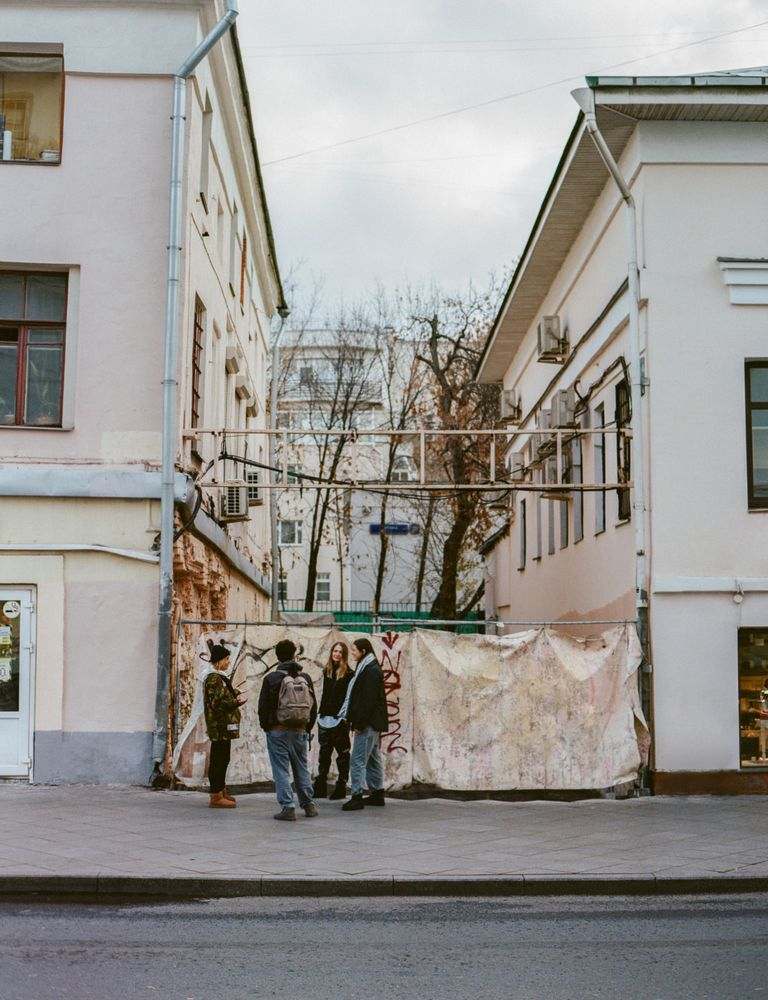
This is a remarkable story about greed and universal justice. In pre-Soviet times, between houses 12 and 14 on Pokrovka Street, there was Tupoy Lane—a small alley leading to a courtyard. In 1925, a shrewd individual decided to construct a commercial building for a store. The “barn” happily survived until 1991, when an investor rented it and turned it into a printing house. In 2016, Pokrovka became a hot property, and the owner decided to “change the interior” a little during the New Year holidays: demolish the old barn and build a larger building. Residents of neighboring houses began to write letters. The Moscow authorities did not appreciate such insolence, and the Arbitration Court ruled that the illegal construction should be demolished.
Justice prevailed in the end: the guys had a lease on the barn-like building they demolished, but since the building was gone and no one had issued a permit for the new structure, there was nothing left to lease.
Georgy Aigunyan: “There used to be a long-term construction project on the site of the ”Yama": one of the Mosproekt studios was building an underground parking lot here. They started digging and stumbled upon the walls of the White City, which were the border of Moscow during the reign of Ivan the Terrible. Under Catherine II, the wall was demolished and boulevards were built, which is how the Boulevard Ring came into being.
Kokhlovskaya Square at the beginning of Pokrovsky Boulevard with part of the White City wall and an amphitheater


Thanks to the My Street project (supervised by Strelka Design Bureau), a public space appeared in Kitay-Gorod. After it opened, only those in the know came here and spent their time quietly. Then people from the neighboring Dixie started coming, and it became quite marginal. Then Lev Protiv started coming, the OMON appeared, and the arrests of teenagers began.
This is the first case in Moscow where people are learning to create and use public spaces outside of parks. Such spaces have appeared in our lives not so long ago, and we are still developing rules of conduct. There are many universities around Yama, and the construction was primarily aimed at this audience. And it really has become their place. But one such space is not enough for Moscow. How to behave in it is also unclear. In the first season, people like us came with pizza from the neighboring Maestrello, a bottle of New Zealand white wine, and cleaned up after themselves. The following year, a different audience appeared — many teenagers migrated here from Gorki Park. There are many people, they are all different, and the main question is how to spend time together. We all need to agree!
So, Kitay-Gorod is not just an old district of Moscow. It is the living heart of the capital, where history is literally layered on every alley and square. From ancient fortress walls and noisy shopping arcades to quiet churches and the first printing houses, you can feel the centuries-old power of the city here.
Today, this place is one of striking contrasts. Walking through it, you can enter a 16th-century temple and exit onto a bustling modern street. Here, business activity coexists with the tranquility of monastery courtyards, and the glass facades of offices reflect ancient domes. This makes Kitay-gorod not a museum, but a constantly evolving organism.
Understanding its history reveals a new side to Moscow. It is the key to seeing the city's true character, shaped over centuries, behind its modern appearance. Kitay-gorod reminds us that the real Moscow is always a dialogue between eras, where the past and the present exist inseparably.


