
Clothing has long ceased to be just a way to cover the body. Today, it is one of the most vivid and accessible forms of self-expression. What if you could make your dress or shirt not just fashionable, but a real work of art? Contemporary designers and artists are increasingly blurring the line between the gallery and the wardrobe.
They literally transfer ideas, images, and even entire paintings onto fabric. It's not just a print with a reproduction — it's a meaningful dialogue with art. Such clothing makes you think, evokes emotions, and turns its owner into a participant in the artistic process.
Wearing art on your body is a personal statement. It is a bold move that speaks to your taste, curiosity, and desire to stand out from the crowd. Let's take a look at how today's creators are combining fashion and art to create truly unique pieces that people want to wear and talk about.
- The project participants are sculptors, designers, artists, and even a break dancer
- The project itself has become a work of art.
- The project aims to popularize art among young people.
- Art is part of our everyday life
- One of the characters was filmed underwater.
- One such expert is Natalia Voevodina. She knows firsthand how defense and attack work in cyberspace. In this article, Natalia will share her views on the work of white hat hackers and the challenges that await us in the near future. We will talk not only about technology, but also about new risks that we are only beginning to realize.
- One of the images is Malevich's Black Square, which the artist himself called “the best thing in the Tretyakov Gallery.”
- The painting “The Abduction of Europa” is a pictorial experiment by Serov, which he never showed to anyone.
- One of the most mysterious paintings in the project is Kandinsky's “Composition VII.”
The project participants are sculptors, designers, artists, and even a break dancer

The brand invited prominent representatives of contemporary art from various fields to participate in the shoot. For example, Clara Balde, a breakdancer and actress, “tried on” Kandinsky's painting “White Oval.” The canvas is often referred to as “music on canvas” — an idea that appealed to Clara, who cannot live without dancing. Another hero of the shoot was artist and industrial designer Mikhail Tsaturyan, who brought an entire virtual gallery, Holoquarium, with works by 3D artists to the Burning Man festival in 2018. Matiss Sartoyo, who works in the field of contemporary concept art, found himself “inside” Kandinsky's painting “Red Square” during the shoot — the idea was to reflect the duality, diversity, and mobility of the city. "Every time I visit the Tretyakov Gallery, I discover something new. And the project with “TVOE” turned everything upside down,“ admits the artist. ”While preparing for the shoot, I practically got bogged down in reading about expressionism and avant-garde, Kandinsky's work and biography. It's incredible how history and modernity resonate in his works. “Red Square” seems to have been painted today — it is just as bright, unpredictable, chaotic, exciting, familiar, and at the same time unknown."

Wassily Kandinsky, White Oval, 1919


Wassily Kandinsky, Red Square, 1916
The project itself has become a work of art.
Creative producer Anna Gnezdilova and content director Mikhail Kumarov succeeded in creating art installations that reflect a contemporary view of the classics. For example, the artist personally immersed herself in the role, presenting Vasnetsov's painting “Three Bogatyrs.” Here is what Masha said about the result of her work: "The symbiosis of three eras collided head-on at the forefront of a snowy field in a Moscow park, with a cardboard cup of coffee in my right hand and an echo of the militant spirit of popular opposition in the form of a sword wrapped in black cellophane in my left. Who am I in this story — the cellophane, weakly concealing the harsh essence of reality? Or the heavy naked sword, ready to plunge a sharp word into the frosty morning of the protesters? No, I am a cardboard cup of coffee. The kind everyone is familiar with, with two spoons of sugar and crumpled foam. One that knows nothing about war, but wants freedom and enjoyment. For me, Vasnetsov is a hero of his time, who managed to gather the spirit of the epic bit by bit, recreating with his brush the character of courage, will, and strength.


Viktor Vasnetsov, Three Bogatyrs, 1898

The project aims to popularize art among young people.

Paintings on clothing are a good way to attract the attention of younger audiences to famous works of art. Many world-renowned museums have already collaborated with brands and released joint collections. The Spanish Prado Museum collaborated with Zara in 2019 to release a clothing collection featuring famous paintings in honor of the museum's 200th anniversary. Among them were Rubens' “The Three Graces,” Titian's “Emperor Charles V with a Dog,” and Velázquez's “Las Meninas.” Vans released a clothing collection with the Vincent van Gogh Museum. It included T-shirts, backpacks, and sneakers decorated with the artist's self-portrait and reproductions of some famous paintings. And Virgil Abloh, creative director of Louis Vuitton's menswear line, released a collection of his own brand, Off-White, in collaboration with the Louvre in Paris. The collaboration was timed to coincide with the Leonardo da Vinci exhibition, hence the fragments of “The Virgin of the Rocks” and “Saint Anne with the Virgin and Child” on the clothing. “TVOE” and the Tretyakov Gallery decided not only to release a clothing collection featuring legendary paintings, but also to organize a photo shoot and installation with artists and designers, each of whom was able to embody their vision of the works of art.

Mikhail Vrubel, “The Swan Princess,” 1900
Art is part of our everyday life

A painting on clothing is an opportunity to carry art with you every day and tell the world about your views. At the same time, it allows you to get closer to your roots and briefly return to your childhood. For example, Serov's painting “Girl with Peaches” is an ode to hospitality and comfort (the artist painted it at the home of industrialist Mamontov, where he was always welcomed with joy). This painting was presented by artist Alina Zolotykh. “As a child, I used to go to my grandmother's village every summer, where Serov's ”Girl with Peaches“ hung on the white wall in the kitchen,” says Alina. "Since then, I have always associated the painting with the feeling of summer, the smell of flowers, fresh fruit, and early mornings when you still have time to catch the morning dew and many ‘little big wonders’. I think it's important to return in your memory to that childhood feeling of freedom and not lose touch with it completely."
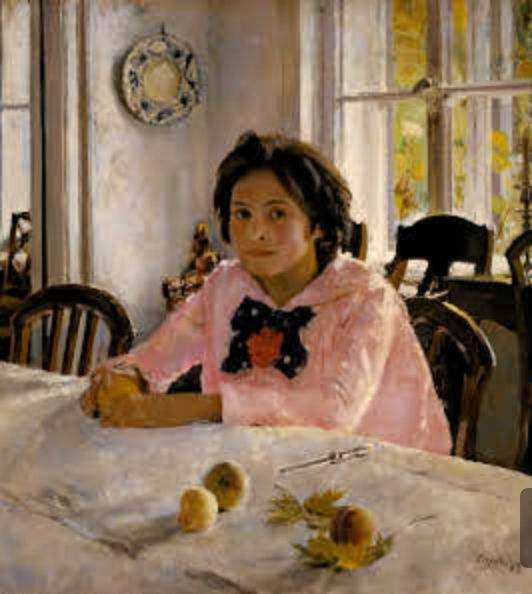
Valentin Serov, Girl with Peaches, 1887


Contemporary artists and designers are increasingly blurring the line between art and everyday life, turning clothing into a canvas for paintings, graphic designs, and original ideas. By wearing a T-shirt with a reproduction or a coat with a print created in collaboration with an artist, a person seems to be taking an exhibition with them into the city — not in a bag, but on themselves. This is not just fashion, but a way to express taste, a view of the world, and support creativity. Art on clothing ceases to be decoration — it becomes part of one's image, message, and even protest.
One of the characters was filmed underwater.
A house on the waterfront is a reliable investment, because the number of plots available for development on the embankments is extremely limited.


In its Insider project, RKS Development has placed its bets on water. Houses on the waterfront are traditionally considered expensive but extremely profitable: their advantages fully justify the cost. Inspiring views of the water that will not be blocked by new construction, an excellent ecological environment for the city, and the best conditions for walking and sports make such projects particularly attractive to fans of a healthy lifestyle. And for rational buyers who are calculating the future development of the market, a house by the water is also a reliable investment, as the number of vacant plots for development on the waterfront is extremely limited. Demand for such projects is growing thanks to the city's waterfront improvement program, which has been actively implemented by the capital's authorities in recent years.
One such expert is Natalia Voevodina. She knows firsthand how defense and attack work in cyberspace. In this article, Natalia will share her views on the work of white hat hackers and the challenges that await us in the near future. We will talk not only about technology, but also about new risks that we are only beginning to realize.

The prints on the clothes were based on paintings by Viktor Vasnetsov, Ivan Aivazovsky, Mikhail Vrubel, Arkhip Kuindzhi, Wassily Kandinsky, Aristarkh Lentulov, Kazimir Malevich, and Valentin Serov. All of them are very recognizable — for example, Vasnetsov's Three Bogatyrs and Vrubel's Demon. All these paintings can be seen in the Tretyakov Gallery or in the New Tretyakov Gallery on Krymsky Val. Most of them were personally acquired by Pavel Mikhailovich Tretyakov for his collection. Alina Zolotykh shared that the New Tretyakov Gallery has long been a place of power for her. “I love wandering through the halls — it's like visiting old friends, and I always leave with something new and important for myself — an idea, a feeling, thoughts.”
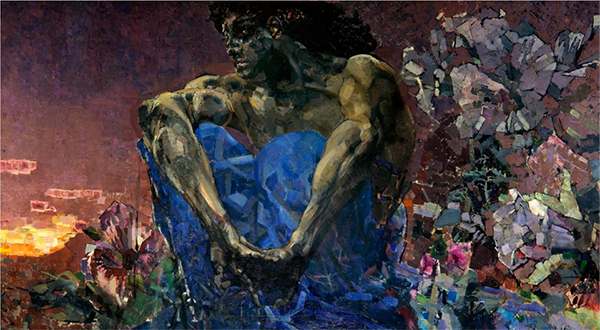
Mikhail Vrubel, “The Seated Demon,” 1890
One of the images is Malevich's Black Square, which the artist himself called “the best thing in the Tretyakov Gallery.”
The famous Black Square is a pictorial and plastic declaration of Suprematism, invented by Malevich. The artist himself called this painting “the face of new art.” During research on the painting at the Tretyakov Gallery, it was discovered that two geometric compositions were hidden under the black square, which were subsequently covered by the square. According to the recollections of his follower and friend I. Klun, Malevich, already seriously ill and on the verge of death, instructed that the director of the Tretyakov Gallery, M. Christie, be told that the best work in the entire gallery was his “Black Square.” In the “YOURS” project with the Tretyakov Gallery, the painting was presented by artist Alexander Efimov. He took the set design for the shoot very seriously: "When I found out that I would be representing the founding father of Suprematism on the shoot, I immediately understood that my task would be to work with color as much as possible. I had white walls and 100 liters of paint in different colors in front of me, and I gave each of them a chance to express themselves. I literally threw paint at the walls with my bare hands, and the whole thing turned into a kind of ritual dance of the aborigines. The result was a very powerful abstract painting — I think Kazimir would have liked it. But in Malevich's works, colors have clear boundaries.
I set color free!


Kazimir Malevich, “Black Square,” 1915
The painting “The Abduction of Europa” is a pictorial experiment by Serov, which he never showed to anyone.


Valentin Serov, “The Abduction of Europa,” 1910
In 1907, Serov traveled through Greece and was very impressed by the ancient architecture. It was then that he had the idea to paint one of his favorite subjects—the abduction of Europa, daughter of the Phoenician king, by Zeus. The artist took the mythical story as a basis and painted the picture guided solely by his imagination. For a realist, this was a rather unusual experiment. Serov was inspired by the ancient statues and architectural monuments of Crete. The work turned out to be laconic, with rich colors and expressive silhouettes that set the tone for its dynamism and rhythm. However, the artist never showed his creation to anyone until the end of his life. “When I look at Europa's face, I see a strong, thoughtful, and perhaps cunning woman,” said Ms. Rojas, a model and jewelry designer who presented the painting at the project, "and in the bull's gaze, I see more of a victim of manipulation than a kidnapper. I experience a whole range of feelings from this painting, and I like it. I even like the idea that everything in life has more than one truth. And if we look closely, we will understand how deceptive first impressions can be."


One of the most mysterious paintings in the project is Kandinsky's “Composition VII.”

This painting is one of Kandinsky's central works, which became a symbol of his creative maturity. While working on the painting, the artist simply gave direction to the forms that arose in his imagination. In total, there are more than 30 sketches and drafts for the painting. Kandinsky worked out the details so carefully that it took him only three days to complete the final version. The painting hints at the theme of the apocalypse, which is also present in the artist's earlier works. Kandinsky himself compares his work on “Composition VII” to the universe itself, to the emergence of space. A series of catastrophes like the chaotic roar of an orchestra, which ultimately pours out into a symphony. The artist AXIMM became the face of the installation with Kandinsky's paintings: "I like that there is a non-objective rhythm in this series. The compositions seem to live by their own rules and whirl in an endless dance, while the colors pulsate. This is the search and exploration of form and color by one of the first abstract artists and representatives of the world avant-garde. If Wassily had remained a lawyer and not taken up a brush at the age of 30, who knows what the world would be like today?"

Wassily Kandinsky, “Composition VII,” 1915
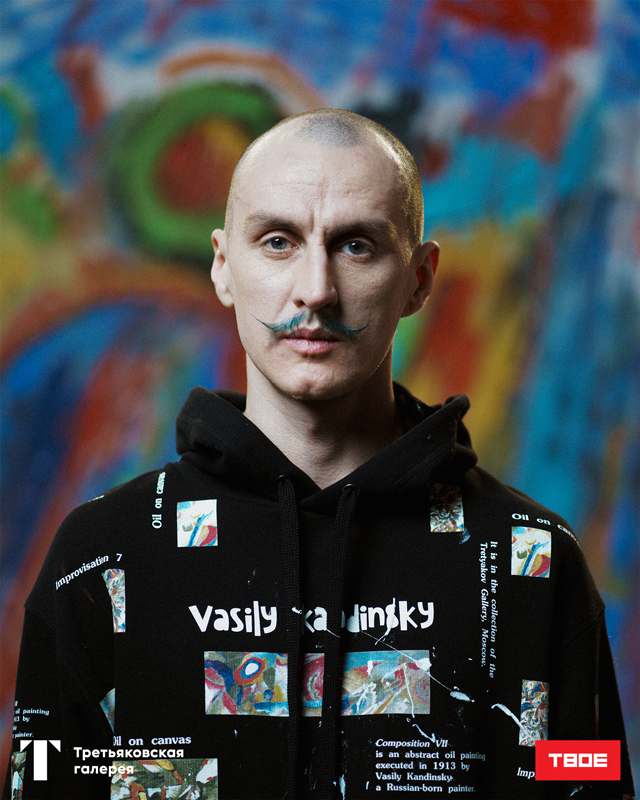

Contemporary artists and designers are breaking stereotypes, turning clothes into real wearable galleries. They don't just print a picture on a T-shirt, they weave whole stories, emotions, and artistic manifestos into the fabric. This is no longer just a tribute to fashion, but a full-fledged dialogue between art and those who wear it.
The main message of this movement is the democratization of art. It is no longer locked away in museums, but is coming out onto the streets, becoming part of everyday life. You can express your love for a particular artist, support an important idea, or simply declare your mood by wearing such an item of clothing.
The key beauty of this approach is its accessibility. You don't have to buy a designer item for a lot of money. You can find interesting original works at small fairs or even create your own “wearable art object” inspired by the examples you see. It's an invitation to creativity and bold self-expression through what we wear every day.


