
When you hear the name Yukio Mishima, you probably think of the famous Japanese writer whose colorful life and shocking ritual suicide became legendary. But another name often appears in the pages of his works: Mishima Mishimorum. Unlike the author himself, this is not a real person, but a complex literary character, one of his alter egos.
It can be said that Mishimorum is the voice that the author used to speak about the most intimate and painful topics. Through this character, Mishima often expressed his ideas about beauty, death, violence, and the eternal search for perfection. He served as a kind of guide to the dark and extreme corners of the human soul that so attracted the writer.
The appearance of this image is the key to understanding Mishima's work. It is not just a pseudonym, but a separate personality created for deep artistic exploration. Immersing ourselves in the works featuring Mishimorum, we enter the very center of Yukio Mishima's inner universe, where the line between life and art is blurred and the author's personal demons find their voice.
“Mishima misimorum” is not just a beautiful phrase in Latin, but a reminder that people often quarrel over trifles, not noticing how this prevents them from truly understanding each other. It suggests that in pursuing our interests, we may lose sight of what is most important: the ability to listen, negotiate, and see common ground. In a world where everyone speaks louder and more confidently, it is worth remembering that sometimes it is easier to make peace than to prove that you are right.
Cover of the book Confessions of a Mask
Many of Mishima's works could be called autofiction, even though they feature fictional characters, and the term itself, coined by Frenchman Serge Dubrowsky, only appeared in 1977, seven years after the famous Japanese writer's suicide. Mishima comes close to the genre popular in contemporary literature in his late essay “The Sun and Steel”: “I searched for a long time for a suitable genre and invented a variety of confessional prose mixed with critical essayism. Let's call my invention a critical confession.”
But, as we know, any public confession, even a “critical” one, is always inseparable from myth-making.
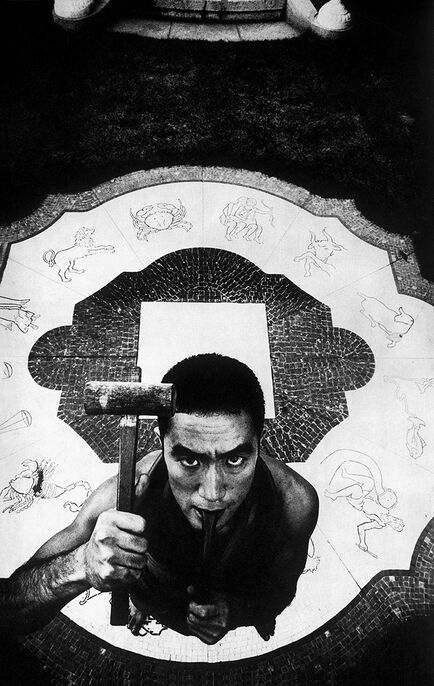
During his 45 years, Yukio Mishima wrote about 100 books, traveled around the world seven times, acted in plays and made films, conducted a symphony orchestra, and released an album of his songs. He was also a member of a UFO research group and created the Shield Society, a paramilitary group that he funded with money from his writing royalties. If we add to this impressive CV his professional bodybuilding career, which resulted in the sickly-looking young man being featured in an encyclopedia article on “Bodybuilding” a few years later, it becomes clear how the writer fits into the modern narrative — a classic example of a liberal self-made man, neurotic, determined, and lacking a strict ethical framework. Despite all the shock value of his everyday behavior, Mishima fits perfectly into the ideal of capitalist and democratic Japanese society, against which he had rebelled so strongly in recent years.
And one cannot help but notice how artificial and constructed this ideal really is. For example, despite his truly great perseverance in training, Mishima paid little attention to his legs, which caused professional bodybuilders to smile ironically, seeing in this gesture aestheticism and the pursuit of media attention. And his pseudonym, which, let us recall, Kimiaki Hiraoka came up with at the age of 16, was written in Chinese characters in the second half of his life in such a way that the resulting inscription read as “a demon enchanted by death with a disgusting tail.”

Cover of the book The Golden Temple
Photo No. 5 from the photo album “Punishment with Roses,” 1961
The Golden Temple, probably the most famous Japanese novel, is devoted to the complex, painful relationship between myth and reality, art and life. The main character of the book is Mizoguchi, a stuttering and introverted Buddhist novice who, inspired by his father's enthusiastic stories about the beauty of Kinkaku-ji Temple, decides to go to Kyoto and enter the service of this temple. Mizoguchi arrives in the city and is disappointed by the building that appears before his eyes, but then becomes obsessed with the ideal image of the temple and decides to burn it down for the sake of true beauty. Perhaps one of the main merits of this book is the feverish feeling that permeates the entire novel, with which a person, together with matter, discovers death and destruction, inseparably fused with this matter. This feeling can drive one mad, as it did Mizoguchi, or one can accept it as an instruction for action, as the writer himself did.
In 1961, Mishima published the short story “Patriotism,” in which he described with incredible naturalism how a Japanese soldier committed seppuku after the emperor's abdication. A few years later, the writer made a film based on his own story and played the leading role in it. And at the end of the decade, he was already putting his plan into action in the field of politics, rather than aesthetics. If we try to apply a simple explanatory scheme to his life, we can say that from an early age, Mishima tried to blend body and word to the point of indistinguishability, to move away from intellectualism toward a primal (and, of course, conservative) life that did not ignore its own mortality.
Many aspects of Mishima's life and work still shape the contours of the modern world. His interest in the body and physicality, among other things, fueled new discussions about biopolitics, feminism, and the boundaries between our own bodies and those of others. The renewed interest in sincerity and direct expression ensured the popularity of the aforementioned autofiction. Mishima's direct heir, Eduard Limonov, who built his life on the model of the great Japanese writer, has already passed away, but last year he was once again the subject of widespread discussion due to the release of Kirill Serebrennikov's film. Right-wing radicalism is experiencing a triumphant rise, but now without any controversy or aesthetic complexity. For every unambiguous characteristic, Mishima had an answer that allowed him to escape appropriation. After the burning, the ashes of the Kinkaku-ji temple were swept away, and an exact replica of the burned building was erected in its place, although an inaccurate and therefore authentic copy had already stood in Mishima's novel many years ago.
The name Mishima Mishimoruma today is a kind of archaeological find, a portrait reconstructed from fragments. His story tells us about the fragility of creative heritage and how many great names can be erased by time through pure chance. It is a reminder that art history is not only a gallery of recognized geniuses, but also a quiet chorus of forgotten voices.
The return of his figure to cultural circulation is an important act of historical justice. It allows us to see the era in which he created more fully and comprehensively, through the prism of yet another talented perspective. It is like discovering a missing piece in a mosaic that helps to better understand the overall picture.
Ultimately, the fate of Mishima Mishimoruma makes us think about what we value and preserve today. Whose names, whose works are we perhaps overlooking? His story is a call to be more attentive to our contemporaries and more careful with the past, because heritage is not only what is visible to everyone, but also what quietly awaits discovery.


