
Sometimes, in order for a dream to become a reality, you have to take that very step after which it is too late to turn back. The story of the creation of the Moscow Theater of Poets under the leadership of Veniamin Smekhov is just such a case. It tells not only about the creative birth of a new stage, but also about the determination of two people who invested not only their energy but also their own funds in it.
In this conversation, the theater's co-founders, Igor Tsvirko and Sergey Danilyan, recall the very beginning: as soon as the first rent payment was transferred, there was no turning back. After that, all that remained was to move forward, overcoming endless organizational and creative difficulties.
Their dialogue is an honest account of what goes on behind the scenes of a cultural project. It is not about the glamour and glitz of premieres, but about finding money for repairs, choosing seats for the auditorium, and believing in an idea when rational arguments might suggest stopping. They talk about partnership, risks, and the adventurous energy without which, perhaps, no real business is possible.
Igor Tsvirko, having decided to rent a theater for his project, felt that he had stepped onto the stage not only physically, but also into a new life—once the rent money had been transferred, there was no turning back. In conversation with Sergey Danilyan, he shares how fear of the unknown turned into determination, why it is important to trust your choice even when everyone around you has doubts, and how one decisive trait can change the course of your career.
- Movement director: Alexander Mogilev
- Chmps Parisse sweater, TSUM
- Chmps Parisse sweater, TSUM
- Maison Margiela T-shirt, TSUM; Dondup jacket, TSUM; MM6 belt, TSUM; Dries van Noten trousers, TSUM; Rick Owens scarf, TSUM
- Pants by Dries van Noten, TSUM; Turtleneck, polo shirt by MUST, TSUM; Boots by Rocco P, NO ONE
- Two Jil Sander vests, TSUM; MM6 trousers, TSUM
- Vest, trousers, loafers by Ermenegildo Zegna, TSUM collect
- Vest, trousers, loafers by Ermenegildo Zegna, TSUM collect
Movement director: Alexander Mogilev
on October 21 and 22, the Helikon Opera will premiere the project “Mystery,” which includes Maxim Petrov's “Russian Dead Ends,” Dmitry Maslennikov's “Monaxia,” and the premiere of Alexander Mogilev's “Demon.” The ideological inspirer and producer of the project (as well as the performer of the main role in Demon, inspired by the fate of Mikhail Vrubel) was Bolshoi Theatre premier Igor Tsvirko.
The Blueprint asked Sergei Danilyan, Igor's famous impresario and teacher at GITIS, to discuss with his young colleague the joys and sorrows of the producer's path: from selling an apartment for the sake of a production to ideas that are born while washing floors.
hover over the portrait.
to find out more,
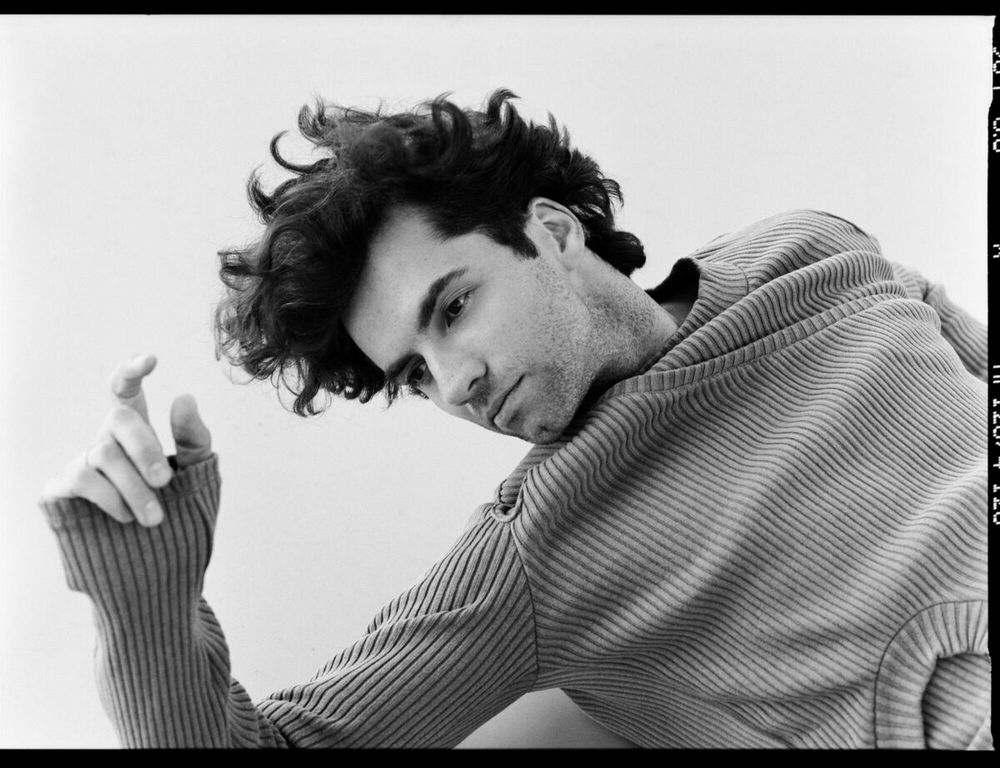
Chmps Parisse sweater, TSUM
Sergei: I usually tell my students a story about how Boris Eifman, when he wanted to become a choreographer, went to Leonid Jacobson and said, “Leonid Veniaminovich, please tell me, how does one become a choreographer?” He replied, “My dear, you don't become a choreographer, you are born a choreographer.” The same applies to producers. It's practically impossible to become one. It has to be something inside you. And judging by the two years you spent in the master's program at GITIS, it seems to me that you belong to the category of people who are born to bring interesting ideas to life. For example, you're not afraid to ask questions and seek advice. But today, I'll be asking the questions. Igor, what motivated you to study to become a producer and take your first steps in a new profession?
IGOR: The pandemic. It made me ask myself questions that you're afraid to ask yourself in everyday life: What's next? What will I do when this is all over? Obviously, I'm dancing now, but what will happen when my body says “no”? I remember that moment perfectly, washing the floor in my kitchen, thinking about a book I had read, and catching myself thinking: how great it would be to stage a ballet based on it. And then the questions began: what would it take to do that? An artist learns a role, rehearses, then dances, but I didn't know what goes on behind the scenes. So the first step on the path to the big goal called “full-length performance” was training. And then, fortunately, I ran into you in the corridor of the Bolshoi Theater and you said, “Come, I'm recruiting for a course.” At the same time, I began to draw on other sources: economics here, accounting there, exhibitions elsewhere. Gradually, people started coming into my life who said, “You have a chance, give it a try.” And finally, a fan of my work wrote to me saying, “Please come to Cyprus with your ballet.” I replied, “If someone invited me, I would be happy to come.” She said, “What does it take?” “We can put on a gala concert.” “Great. What does it take?” So I asked a friend to analyze venues and audiences in Cyprus, and we've already held the Celebrity Ballet Gala there twice. And just a few days ago, we gathered 3,000 spectators in two days at the ancient Greek theater of Curium, where ballet of this level has never been performed before. Meanwhile, we had a chance to do something in Moscow. We had a project in February. And now the premiere of “Mystery.”
Chmps Parisse sweater, TSUM
Sergey: What was the name of the book that started it all?
IGOR: It was The Picture of Dorian Gray. I had even sketched out the set design in my notebook, and all that was left was the small matter of… But, as my first experience in production taught me, the main thing is not who came up with the idea first, but who was the first to bring it to life. Actually, at the very beginning, I wanted to do an evening of one-act ballets called Shadows. One morning, I woke up, opened social media, and saw that NDT was releasing its new season program, which included Shadows. Oh, my thoughts are flying around in the air, apparently. After a while, I visited their page again, and there was The Picture of Dorian Gray. They're eavesdropping on me! I think further. A new idea! I come to you and say, “Sergei Benikovich, how do you like the title ‘Facets’? It's good, multifaceted!” And I hear, "But Diana Vishneva and I did a project called ‘Facets’. I went through so many titles before settling on ‘Mysteries’… About twenty."
Maison Margiela T-shirt, TSUM; Dondup jacket, TSUM; MM6 belt, TSUM; Dries van Noten trousers, TSUM; Rick Owens scarf, TSUM
SERGEY: I have a very funny story related to the title of the project “Beauty in Motion.” When Diana and I were planning this project, she was a guest prima ballerina with the American Ballet Theatre and was preparing for the premiere of “Sleeping Beauty.” And then I opened American Vogue and couldn't believe my eyes: there was a photo of Diana from Sleeping Beauty, not from ABT, but from the Mariinsky Theatre, and the headline was “Beauty in Motion.” I thought, damn, this is what I need! I called the magazine and explained the situation. They replied, “Go ahead, we don't patent the names of texts.” And so we named the project “Beauty in Motion.” It sounded beautiful in both Russian and English. And recently, I decided that the names of all the projects I have created are free to use. If someone wants to do a project with the same name, I'll support them. The only condition is that they must indicate when and by whom the original project was created. And recently, a wonderfully crazy person appeared in St. Petersburg who put together a program called “Kings of Dance: The Return.” He took the best works from our project and showed them with new artists, including Leonid Sarafanov and Ivan Vasilyev. It is being prepared for screening in Moscow. And I am pleased that this has happened. In general, I think that projects should live long and change over time.
Pants by Dries van Noten, TSUM; Turtleneck, polo shirt by MUST, TSUM; Boots by Rocco P, NO ONE
IGOR: Artists change too. You look at the new generation, and they're different… Free, independent, without any mental blocks, which I think I had and still have. Like, if you go on stage, you have to do everything perfectly right away. Or if you're given a role, you can't say no. Nowadays, young people immediately show with their whole demeanor that they're not going to dance. And for some reason, it works. The strict disciplinary framework in which several generations were raised is fading, and people are starting to say, “I don't want to and I won't.” And, accordingly, everyone has to adapt and come to an agreement. And to put it bluntly, every man in the art form known as ballet is worth his weight in gold, and if he is also talented, then he must be retained by all means available. Otherwise, there may soon be no men left. The most striking example of this so far is François Alu, who was awarded the title of étoile at the Paris Opera and literally left the building a month later. The man had reached the peak of his career. He said, “Great, I've done it,” and went off to pursue his own projects.
SERGEY: Or there was the story with NY City Ballet ballerina Alexandra Ansanelli. Charming, young, trained—she had it all. And then suddenly she left, also at the peak of her career. I took the trouble to find her and ask what had happened. She replied, “I felt completely empty, I realized I had nothing left to do here.” NY City Ballet is Balanchine's theater, and she had danced everything.
Two Jil Sander vests, TSUM; MM6 trousers, TSUM
IGOR: What can keep a dancer from leaving? A high salary—yes, but not for long. The main thing is the opportunity to be involved in something new. To work with an interesting choreographer, participate in a big project, create something yourself. There was a moment when I reached the peak of my career as a soloist, outgrew the roles I was dancing, and realized: apparently, that's it. And at that moment, Pierre Lacotte arrives, begins to stage Marco Spada, inexplicably singles me out and simply puts me on the list for the lead role. It's clear that after that, I was ready to do anything to dance this part.
SERGEY: Alexandra Ansanelli's story, by the way, did not end with her departure from the stage. In America, unlike in Russia, where a ballet dancer can retire after a 20-year career, no one gives you a pension at 38. You have to find some other use for yourself. And NY City Ballet created a fund that helps artists learn a new profession. And so Alexandra Ansanelli became a doctor. In Russia, you can study to become a producer at GITIS, Moscow State University, or the MHAT School-Studio. When I transferred from the theater studies department at GITIS to the economics department in the late 1980s—because I met my future wife, Gay, in the hallway of the institute and realized that I couldn't support a family on a theater studies salary— the profession of producer did not exist, there were not so many institutions willing to support cultural projects, and I had to learn from my mistakes.
Vest, trousers, loafers by Ermenegildo Zegna, TSUM collect
IGOR: Well, not much has changed.
SERGEY: For my first project in America—a concert performance of the opera Ruslan and Ludmila in costumes by Valentin Yudashkin—I had to sell my apartment in Moscow. And it failed because I didn't know the laws of the market, I didn't have any connections. My address book was empty. Now it's thick. And you know what's funny? In 2019, during Boris Eifman's theater tour in New York, I was sitting in the audience, and a large African American man sat down next to me and asked if I was the producer of the show. I introduced myself and asked if we knew each other. He replied, “No, but the owner of the apartment in Moscow sends her regards. Remember, the Japanese pianist bought it from you?” “You know,” I replied. “I'm going back to Moscow. Maybe she'll sell it back to me?” “Yes, of course, for $2 million.” I sold it for $50,000. And I am absolutely sure that I spent that money wisely.
IGOR: Why didn't it work out with Ruslan and Ludmila?
SERGEY: During the Soviet Union, Gostkoncert took the Bolshoi Theater and the Mariinsky Theater (then known as the Kirov Theater) on tour. When the Union collapsed and the theaters began working directly with foreign agents, the price tag changed. It was no longer possible to pay the artists 2 kopecks, and it turned out that taking 200 people on tour was too difficult and expensive for anyone to want to do it. You can't move from city to city every day; you have to stay in one place for a week. And the theaters themselves realized that they didn't need to go on tour, they could earn just as much here. Touring became more of an image-building tool. That's why it was necessary to come up with new, more compact formats. At that moment, I didn't have the status of an agent, I didn't have a team. I built everything up gradually. But by 2000, we were already touring 10 cities in America. Later, we entered the British market. At the same time, I continued to bring my projects to Russia, which was important. And in 2009, we received three Golden Masks for Beauty in Motion. And when you're just starting out as a producer…
Vest, trousers, loafers by Ermenegildo Zegna, TSUM collect
IGOR: You think the world is just waiting for your project (laughs). Actually, I think the decisive moment for me was when I transferred the money for the theater rental. You had already come up with a program, found people, found a stage, and even managed to squeeze into its schedule in the middle of the season… And then they ask you, “Are you paying the rent or not?” And you realize there's no turning back. If you cancel, you'll lose the money and have to pay a penalty. And that's what you've worked for over many years… So you decide, yes, the project will happen. And no matter what it takes, I'll find the money. By the way, I still have a card for my car on Auto.ru with all the details, all I have to do is press the “sell” button. And of course, no organization or institution is willing to give money to a novice producer. I understand that perfectly well, but I am ready to prove that I can be trusted and that we can work together in the future. But you know how it is when you apply for a job and they write “3 years of experience required.” Where do you get those three years? Anyway, now I know that you have to start fundraising at least six months before you start implementing a project, and I understand the role of presentation and the importance of networking. And I'm a shy person in everyday life. I have to overcome a lot. And thank God there are people who support you. Thanks to my co-producer Ekaterina Dementieva for the projects in Cyprus. And of course, to my wife Kristina (lead soloist of the Bolshoi Theater Kristina Kretova. — Note. The Blueprint) for believing in me and supporting me every step of the way. Everyone around seems to think that finding money in Russia is easy, but remember the phrase from one of the Marvel movies: “With great power comes great responsibility.” It's the same here: with big money comes huge responsibility. And that's the responsibility of a producer. I'm glancing at my phone out of the corner of my eye, and there are 20 messages from Mauritius, Chile, and somewhere else, and everywhere they want dancing. And I have to respond to each one. And I also need to rehearse and fulfill my direct duties as a ballet dancer… So when people ask me, “When do you rest?” I answer: on stage. Because that's where I know exactly what to do.
SERGEY: It would be easier if I devoted myself entirely to producing. Having to be here and there takes a lot of energy. And time. There are rehearsals, the repertoire…
Chmps Parisse sweater, TSUM
IGOR: Yes, yes, it's very difficult. At the same time, you have to keep track of the numbers, how tickets are selling, how the advertising is going, who is dancing what. Where to put the scenery, after all! Alexander Mogilev says to me, “I want a rock on stage.” “Sanya, do it.” For me, “Demon” is a very important project, everything has to be perfect, and then we'll figure out the money and everything else. And so we arrive at the production… And there it is — 6 meters long and 2 meters high. And I still need to interact with this “object” as freely as possible, as Sasha says. At a height of two meters. And there is no place to put this stone and interact with it, except on stage. So we rehearsed in the studio, and there will be only one rehearsal with the stone, at night, on the eve of the premiere, while they are setting up the lighting. I'll have half an hour to try it out — ideally, 10 minutes — that's fine too. It's like when we discuss lighting and smoke with the technicians, and they say to Sasha, “It's unlikely that it will work the way you want it to.” And he says, “Unlikely is fine with me.” Don't be afraid, just do it. Period.
Photographer's assistant: Alexandra Tikhnenko
STORES:
TSUM
MOSCOW, PETROVKA STREET, 2
8 (495) 933-73-00
NO ONE
MOSCOW, KRASNAYA PLOSHCHAD STREET 3
8 (495) 620-33-23
THE EDITORIAL TEAM THANKS THE GARAGE MUSEUM
FOR HELP WITH THE SHOOT
The conversation between Igor Tsvirko and Sergey Danilyan is an honest and very personal discussion about what it means to be a producer in contemporary theater. They make no secret of the fact that it is a path fraught with financial risk and enormous responsibility. The phrase “once you've transferred the money for the rent, there's no turning back” becomes key — it's the point of no return, after which the real work begins, requiring complete dedication.
The speakers' stories show that success does not come by chance. Behind every project are sleepless nights, difficult negotiations, and the ability to make unpopular decisions. It is important that they talk not only about money, but also about creative courage, about the need to believe in your idea, even when those around you do not believe in it.
Ultimately, this dialogue is about a great love for the theater. It reminds us that behind the scenes of spectacular premieres lies the titanic work of people who take risks and bear responsibility for the entire process. Their experience is an invaluable lesson for anyone who wants to create something of their own, where art and entrepreneurship go hand in hand.


