
Maria Mikhalkova-Konchalovskaya was born into a famous creative family, but for a long time did not consider a career in cinema. She tried her hand at other fields—she studied psychology and worked in fashion. For many, she was primarily the daughter and granddaughter of famous parents, rather than an independent figure in the arts.
Everything changed after a meeting with director Valeria Gay Germanika. She was the one who saw Maria's acting potential and offered her a role in the series A Short Course in Happy Living. This project became a real turning point for Mikhalkova-Konchalovskaya and opened the way for her to a profession she had never even dreamed of before.
In her interviews, Maria recalls this period with warmth and gratitude. She candidly recounts how working with Germanika helped her believe in herself, stop being just “the girl from a famous family,” and find her own voice. Her story is a vivid example of how a word spoken at the right time and a chance given can completely change a person's life.
- Maria, tell us what the casting for the series “Mutual Consent” was like for you. Valeria Gay Germanik is interested in working with non-professional actors, she has her own special approach to finding characters…
- Speaking more about Zhenya, what important traits did you discuss with Valeria? Perhaps you had difficulties with something, at certain moments you couldn't understand her, or, on the contrary, you easily accepted the character?
- Many actors who have worked with Valeria say how worried they are that they won't be able to find another director who immerses them in a project like that. How was it for you? What were your concerns before you started working with her? Or, on the contrary, did you have no concerns?
- I am inspired by the opportunity to see that spark in a person that they may not even notice themselves, and to help it grow into a real fire. I see myself not as a boss, but rather as a friend who has walked a similar path. Imagine a child climbing a tree and shouting, “Look at the sun!” while the adults grumble, “Come down, you'll get dirty.” I, on the other hand, want to say, “Climb higher, you can see the sea from there!” I also get incredibly energized when an artist suddenly realizes that their music isn't just “good enough,” but has become a part of someone's life.
- You call yourself an artist on social media. Does this word mean something more to you than just your work? Judging by what you just said, it really is something more, and acting is also a form of art for you, a form of co-creation.
- You have a very bright style of clothing, and your photographs are also bright and cheerful. How did you come to this? Perhaps certain directors or artists influenced your style?
Maria, tell us what the casting for the series “Mutual Consent” was like for you. Valeria Gay Germanik is interested in working with non-professional actors, she has her own special approach to finding characters…
I met Lera at her interview with my mother, Lyubov Tolkalina. Lera has a YouTube show called “Lera in the Big City.” The filming took place at my mother's theater, Sobor, and I had forgotten something there. I went inside and saw the interview. As a result, I was invited to join. That's how we met, and then it turned out that we both go to the same confessor, Dimitry Roschin, at the church on Three Mountains. and it also turned out that we had many mutual acquaintances. About six months passed, and Lera invited me to audition for the role of Zhenya. Later, I was told that no one else was considered for the role, meaning that she had already chosen me in advance, and my fate in this regard was predetermined.
 Maria Mikhalkova-Konchalovskaya
Maria Mikhalkova-Konchalovskaya admits that she did not immediately pursue an acting career and did not even plan to become an actress. Everything changed after she met Valeria Gay Germanika, a person who believed in her, gave her a chance, and helped her believe in herself. This story is about how important support is, and how sometimes one inspiring person is enough to change your perception of the future.
Speaking more about Zhenya, what important traits did you discuss with Valeria? Perhaps you had difficulties with something, at certain moments you couldn't understand her, or, on the contrary, you easily accepted the character?
Zhenya is an ambiguous character. She is a collective image of a child who grew up in a dysfunctional family. She clings to the facade that her father, Grigory Venishev, tried so hard to build. Grigory Venishev. But behind that facade lies a great deal of pain that she cannot control. In this respect, she is the absolute product of her parents — an infantile mother and a despotic father. Seeing who is in charge in this couple, she copies him — that is, her father — and becomes a “second father.” She has mental health issues—nothing serious, but they affect her behavior. Lera and I discussed this in advance. Zhenya is like me when I'm depressed. She is a melancholic, courageous girl, but clearly has a strong personality and really wants to escape the darkness that surrounds her.
Lera asked us all to keep diaries from the perspective of our characters. This is because it allows actors to immerse themselves more deeply in the story. I know for sure that Glafira Tarkhanova kept such a diary. She always carried it with her on set. Since I keep a personal diary, I simply started an additional notebook for Zhenya and wrote entries from her perspective. When we received new episodes or script revisions, I wrote down exactly what she was feeling in each scene. This was to better understand the character and be more organic within the character.
 “Mutual Consent”
Many actors who have worked with Valeria say how worried they are that they won't be able to find another director who immerses them in a project like that. How was it for you? What were your concerns before you started working with her? Or, on the contrary, did you have no concerns?
There are different opinions about working with Lera: some people really like it, some people really dislike it. Filming for the project was indeed difficult. But since I didn't have much experience, I got through it quite comfortably. This is my first big role on screen. I was fascinated by the process and the realization that this was happening to me.
The theme of our summer issue is “Territory of Love,” and it's very symbolic that your profile on one of the social networks includes the phrase “Soldier of Love.” Can you share what meaning you put into this phrase?
 “Soldier of love” is not just a beautiful line from a song by my favorite artist, Sade, but my personal philosophy. For me, love is not an abstraction, but a territory that must be defended every day. Just as a soldier defends borders, I protect what I believe in: sincerity in creativity, the courage to be yourself, and the right to a voice for those who are just starting out. Once upon a time, I myself entered the world of music with a shield of naivety, and instead of a sword, I had only my voice. Then I realized that love for one's work is not a romantic impulse, but hard work. And for me, the territory of love is where there is no place for cynicism. The world should be ruled by love — pure, sincere, unconditional.
I am inspired by the opportunity to see that spark in a person that they may not even notice themselves, and to help it grow into a real fire. I see myself not as a boss, but rather as a friend who has walked a similar path. Imagine a child climbing a tree and shouting, “Look at the sun!” while the adults grumble, “Come down, you'll get dirty.” I, on the other hand, want to say, “Climb higher, you can see the sea from there!” I also get incredibly energized when an artist suddenly realizes that their music isn't just “good enough,” but has become a part of someone's life.
The fact is that my main profession is that of an artist. I illustrate books and paint pictures. I don't have a classic acting background. Young actors usually graduate from university, then star in projects, and grow to become truly famous, worthy directors. By chance, it didn't work out that way for me. And now, after working with Germanica, I really have set the bar high for myself. I was already thinking that I should finish some kind of film school or hire an acting coach. I don't have professional training as an actor, but I do have theater school behind me and some experience.
I like acting in films, but I'm not considering a classic acting career. I decided to try my hand at cinema because Valeria and I were on the same wavelength in terms of the project, our vision of the story, and our general outlook on life and values. And on set, which was very valuable to me, I was able to have my own point of view, despite the director's authority. And if my idea was good, Lera listened to it — I am very grateful to her for that. In other words, in a way, I brought something of my own to the project, rather than just following instructions. I like creating a character by immersing myself in it, thoroughly understanding what is happening to it. This is very valuable work, even from the point of view of my personal development of emotional intelligence. And I would like to work with directors who work the same way as Valeria, because it is very different from the classic understanding of the directing profession; there is something alive in it. It often happens that there is no soul on the set, everyone just does their job, and the actors are often not interested in what they are filming. This is called “doing an actor's job,” and I don't want to do that. But I definitely need to improve my skills and constantly develop so that I am worthy of participating in good projects.
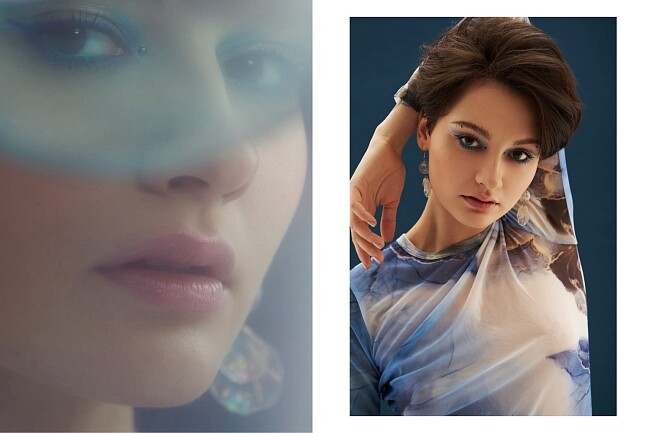 Maria Mikhalkova-Konchalovskaya
You call yourself an artist on social media. Does this word mean something more to you than just your work? Judging by what you just said, it really is something more, and acting is also a form of art for you, a form of co-creation.
My main job is selling paintings, organizing exhibitions, illustrating children's books, and sometimes collaborating with fashion designers. I didn't think I would become an actress until I met Lera. I was very far from it. But I considered becoming a director later, like my dad or my grandfather. But the thing is, a director is still an adult. I can't become a director at 22 because a director is someone who has something to say. And that implies a certain amount of life experience. But I really call myself an artist. My lifestyle is such that I just really enjoy being involved in creating something valuable for people. And what that is, in fact, doesn't matter: if I can do it in theory, I'll do it. I paint pictures, I put on exhibitions for people. We collaborate with designers, we stage plays. I also work as an artist at my mother's theater. And I starred in Valeria Gai Germanika's series primarily so that people would watch it and perhaps understand or discover something for themselves. My favorite thing to do is interact with the world around me through creative activities. It's the only thing I can be useful at, and it's my tool for self-identification in life.
 Maria Mikhalkova-Konchalovskaya
You have a very bright style of clothing, and your photographs are also bright and cheerful. How did you come to this? Perhaps certain directors or artists influenced your style?
I don't really have a specific style of clothing. My mother, for example, has a style. But I have a very diverse wardrobe, and I have several different mental states — probably because of what's going on in my life. There are some really cheerful looks that I often share on social media because they're the most attractive. But I change my looks very often. And my behavior changes depending on my look. That's why I feel comfortable, for example, in very flamboyant and bright clothes, but at the same time, I felt good in the look of Zhenya from “Mutual Consent.” Zhenya mainly wears a relaxed, semi-sporty, casual style, and on the street she generally walks around in a leather raincoat à la “The King and the Jester.” And I felt absolutely comfortable in that. It was literally me — just one of my personas. And her sad, dark, noir, depressive style also suited me perfectly. In fact, the only thing I did to be the character was to just keep myself in that state. In fact, Zhenya is one of my alter egos! When I'm in a complicated emotional state, I'm Zhenya.
But if we're talking about my favorite clothing designers, the people who shaped my stylistic preferences, then I would probably name Vivienne Westwood, Rei Kawakubo, Yayoi Kusama, and, of course, Alexander McQueen. No matter what role I'm in today, I will always choose layering, complexity of image, contrasting colors and textures, and I will always wear a lot of jewelry.
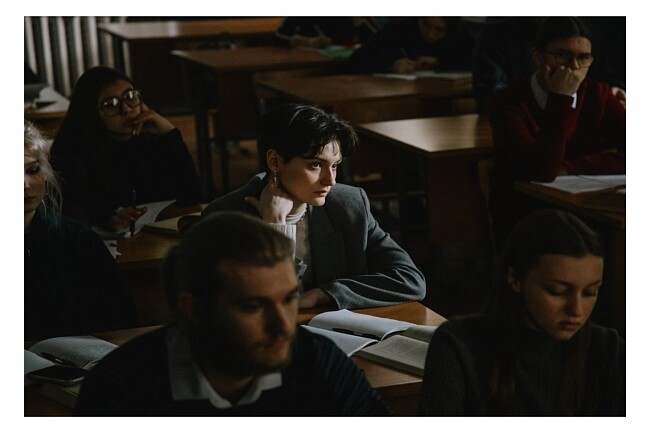 “Mutual consent”
The story of Maria Mikhalkova-Konchalovskaya is a good example of how your life trajectory can change after meeting someone who sees your potential. For a long time, she herself did not consider acting as a serious option until fate brought her together with director Valeria Gai Germanika.
This meeting was a turning point for Maria. Not only did she discover a new profession, but she was also able to rethink her own capabilities. Her journey reminds us that sometimes we need someone from the outside to help us see what we ourselves cannot see.
Thus, Maria's career is a story about believing in people and having the courage to take on new challenges. Her experience shows that it is important to remain open to unexpected offers and trust your intuition, even if your initial plans were completely different.


